| Absolute Encoder |
| An absolute encoder provides information
in the form of unique output for every resolvable movement of
motion or shaft rotation. |
| Accuracy |
| Related to the incremental encoding disk.
It is the difference between the theoretical position of one
increment or bit edge and the actual position of the edge. |
| Ambient Temperature |
| The average or mean temperature of the surrounding
air which comes in contact with the equipment and instruments
under test. |
| Axial Loading |
| The force applied to a shaft end surface
directed along the axis of rotation. |
| Axial Load (maximum) |
| Maximum axial load is the maximum force that
may be applied to the shaft without reducing the rated operating
life or causing deviation from the rated performance. |
| Bi-directional |
| Bi-directional refers to an encoder output
code format from which direction of travel can be determined. |
| CE (European Compliance) |
| Sets essential electromagnetic compatibility,
within the European markets, for all electrical and electronic
equipment that may interfere with other equipment, or that may
be interfered with other equipment. |
| Channel |
| Each channel is a unique incremental output
of the encoder. |
| Complementary |
| Complementary is the term
for two identical periodic signals where one signal is electrically
inverted from the other. Example of single channel electrically
inverted. Complementary signals are typically generated by inversion
of the electrical output from a single channel. |
| Current Sinking Output |
| A logic form that requires current flow out
of the input of the PLC or counter and back to the output of
the encoder. The encoder sink this current, which is sourced
by the input circuitry. This is the most common output circuit
configuration. It uses an NPN output transistor in the encoder. |
| Current Sourcing Output |
| A logic form that requires current flow from
the output of the encoder to the input of the counter or PLC.
The encoder sources the current and the input circuitry of the
counter or PLC sinks this current. This output circuit is seldom
used. It usually requires a PNP output transistor in the encoder. |
| Cycles Per Revolution (CPR) |
| The number of increments on the disk of an
incremental encoder. A one thousand increment encoder has a
CPR of 1000. |
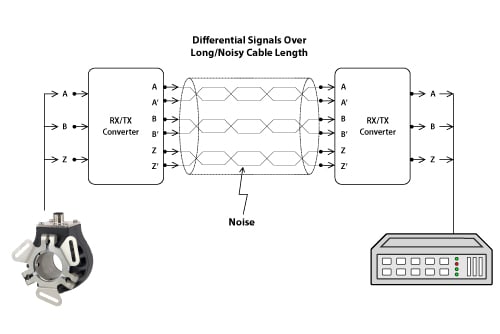
| Differential Line Driver |
|
Output stage of the encoder which produces two "complementary"
pulse trains per output channel. These complementary outputs
can be transmitted through long cables with minimal loss of
signal integrity. Electrical noise effects are reduced when
the signals are compared by the "differential line receiver".
Receiver input impedance should be matched to the line driver
output and the transmission line for best noise immunity.
|
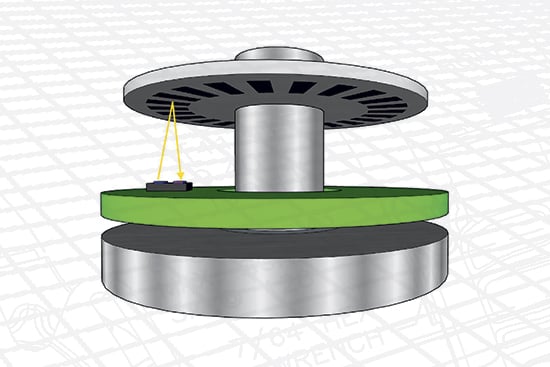
| Disk |
| Typically made of glass, metal or plastic
with precise position incremental lines. These lines are also
known as increments. The number of increments determines the
resolution or CPR of the encoder. |
| Dual Channel |
| A dual-channel encoder produces
two incremental outputs. These two outputs are generally in
quadrature (90° phase separation) relationship to each other.
They are typically referred to as Channel A and Channel B. |
| Duty Cycle |
| The total time to complete
one on/off cycle |
| Encoder (shaft type) |
| An encoder is an electro-mechanical device
that translates mechanical motion (such as position, velocity,
acceleration, speed, direction) into electrical signals. |
| Frequency Response |
|
Frequency response for an incremental encoder is the maximum
frequency of the output signal in Hertz.
|
| Incremental Encoder |
|
An incremental encoder is a device which provides a series
of periodic signals due to mechanical motion. The number of
successive cycles corresponds to the resolvable mechanical
increments of motion.
|
| Index Reference |
The index is a separate output generated
by a special track which produces a single cycle (or transition
change) at a unique position or positions such as center, home,
zero, or reset point. Sometimes referred to as a marker pulse.
|
| IP 50 |
| Protected against dust. Limited ingress (no
harmful deposit). |
| IP 64 |
| Totally protected against dust. Protected
against water sprayed from all directions. Limited ingress permitted. |
| IP 65 |
| Totally protected against dust. Protected
against low pressure jets of water from all directions. Limited
ingress permitted. |
| IP 66 |
| Totally protected against dust. Protected
against strong jets of water. Limited ingress permitted. |
| Line Count |
| Line count is the number
of equally spaced radial lines per 360 mechanical degrees on
the incremental encoder code disk. |
| Line Driver |
| A circuit that provides error-free output
pulses in electrically noisy environments or over long transmission
lines when used with a line receiver. |
| Negative Going Pulse |
| When activated, the pulse goes low (logic
0) or in a negative direction. Do not be confused by negative
going, meaning the pulse goes negative in relationship to the
signal common or reference level. These statements are for positive
logic only. All shaft encoders are based on positive logic. |
| NEMA 4 |
| Enclosure rating intended for indoor or outdoor
use primarily to provide a degree of protection against windblown
dust and rain, splashing water, and hose directed water; undamaged
by the formation of ice on the enclosure. |
| NEMA 13 |
| Enclosures are intended for indoor use primarily
to provide a degree of protection against dust, spraying of
water, oil and noncorrosive coolants. |
| Noise |
| An undesirable electrical
signal from an external source such as an AC power line, motors,
generators, transformers, fluorescent lights, CRT displays,
computers, radio transmitters, and others. |
| Open Collector Output |
| When the signal is taken directly off the
collector element of the output transistor, no pull-up is used.
This is the electronic equivalent of a mechanical switch closure
to common. The input device of the PLC or counter is effectively
placed in a series circuit that includes the output transistor
and input device, which is often an optosolator and the positive
voltage supply. When the output transistor turns on, the circuit
is completed and current will flow. The output signal can not
be observed unless the circuit is completed externally. |
| Phase |
| Phase is electrical degrees
of displacement between two encoder outputs, typically 90°
in quadrature encoders. |
|
Position Error
|
| Position error is the difference
between the theoretically correct shaft position and its position
as indicated by the encoder cycle count. |
| Positive Going Pulse |
| In the low or logic 0 state, it is in the
quiescent state. It goes high or logic 1 when activated. This
is a transition in the positive going direction. |
| Pulses Per Revolution |
| Number of pulses occurring in one revolution
of the encoder shaft. |
| Pulse Polarity |
| Either positive going or negative going.
A pulse has two logic states: activated or inactivated. These
two states are opposite. When the pulse is in its quiescent
state (high or low), it is at one particular logic level (1
or 0). When the pulse hits or is in the activated state, this
logic level reverses itself for the duration of the pulse. |
| Pulse Width |
The actual real time between identical points
on the leading or trailing edge of a pulse to the next successive
leading or trailing pulse edge. The pulse width of the output
signal of most encoders is a 50% duty cycle on the clock outputs.
Some models utilize a timed or "one shot" output.
This provides a constant pulse width irrespective of the pulse
repetition rate or shaft speed. The factors to be considered
when determining pulse width specifications are: (1.) What is
the minimum pulse width requirement of the counter or PLC? This
information is available in the counter or PLC specifications.
(2.) Pulse repetition rate versus pulse width. With a constant
pulse width, the individual pulses become closer together as
the pulse
repetition rate or shaft speed increases. At some point the
pulses will overlap and the output signal as a series of well
defined pulses ceases. The pulse repetition rate varies inversely
with the pulse width and vice versa. |
| Pull-up Resistor |
| When added inside the encoder between the
positive voltage and the collector element of the output transistor,
it becomes a pull-up circuit. This is also know as a pulse output. |
| Push-Pull Output |
| An output circuit that will both sink and
source current. |
| Quadrature |
A dual output encoder used for bi-directional
motion control. One channel leads the other by 90 electrical
degrees. By monitoring the phase shift of both channel A and
B, direction can be determined. Another benefit of a quadrature
encoder is
count multiplication. With an appropriate counter, resolution
can be multiplied up to four times. For instance, using this
technique an encoder with CPR of 1000 can provide a resolution
of up to 4000 pulses per shaft revolution. |
| Quadrature Error |
| Quadrature error is the phase error when
the specified phase relationship between two channels is nominally
90 electrical degrees. |
| Radial Load |
| The force applied at a specific point to
the encoder shaft perpendicular to the axis of rotation. Note:
It is important to note where the force is being applied along
the shaft, due to the cantilever effect. |
| Radial Load (maximum) |
| The maximum force that may be applied perpendicularly
to the shaft without reducing the rated operating life or causing
deviation from the rated performance. |
| Resolution |
| The number of increments on the encoder disk.
For incremental encoders, resolution is defined as cycles per
revolution. |
| Shaft Runout |
| Amount of shaft movement while spinning. |
| Single Channel |
| A single channel encoder produces one incremental
output. They are often used for tachometry applications. |
| Solder Terminals |
| For applications that require direct solder
connections to the shaft encoder. |
| Symmetry |
| Symmetry is the ratio of
the ON time to the OFF time of the output signal for one channel.
This ratio is optimally 50-50. |
| TIR |
| Total Indicator Reading |
| Torque (running) |
| Running torque is the rotary force required
to keep an encoder shaft turning. It is typically expressed
in ounce-inches. |
| Torque, Starting (breakaway) |
| Starting (breakaway) torque is the rotary
force required to overcome static friction and cause the encoder
shaft to begin rotating. |
| Unidirectional |
| Unidirectional refers to an encoder output
code format from which direction of travel cannot be determined. |